School Marketing Trends for 2026
School marketing keeps shifting underneath our feet. Parents research differently each year, new channels emerge, and the gap widens between schools that adapt and those still relying on the prospectus-and-posters playbook. Here are the school marketing trends that will matter most for UK schools in 2026.
AI Search Is Changing How Parents Find Schools
Parents increasingly get answers from AI — Google’s AI Overviews, ChatGPT and similar tools — rather than clicking through ten blue links. When a parent asks “what are the best independent schools near Manchester?”, the schools mentioned in the AI’s answer win the shortlist.
What to do about it:
- Publish genuinely helpful, specific content that AI tools want to cite (fees, entry requirements, transport, results in context)
- Keep your information consistent across your website, Google Business Profile and directories
- Maintain strong reviews and third-party mentions — AI answers draw heavily on them
Short-Form, Authentic Video Keeps Winning
Polished promotional films have their place, but the content parents actually watch and trust is short, real and frequent:
- Day-in-the-life clips and classroom moments
- Pupil and staff voices, unscripted
- Quick answers to common questions (“What’s the food like?”, “How does settling in work?”)
- Event recaps and open day invitations
Vertical video for Instagram Reels, TikTok and YouTube Shorts now reaches prospective parents — and increasingly, prospective pupils themselves influence the choice.
First-Party Data and CRM-Driven Personalisation
With third-party tracking continuing to decline, the data schools collect themselves is becoming their most valuable marketing asset:
- Enquiry and registration data feeding a proper admissions CRM
- Segmented email journeys by year group, entry point and interests
- Personalised follow-up based on what a family actually asked about
- Careful UK GDPR-compliant consent management as the foundation of it all
Schools that nurture their own database well depend less and less on paid reach.
WhatsApp and Conversational Communication
Email open rates aren’t what they were, and parents increasingly expect the immediacy they get everywhere else:
- WhatsApp or SMS for open day reminders and quick questions
- Live chat or chatbots on school websites for out-of-hours enquiries
- Faster, more personal responses as a baseline expectation
For international families in particular, WhatsApp is often the default channel — meeting them there removes real friction from overseas recruitment.
Hybrid Admissions Journeys Are Now Standard
The virtual/in-person distinction has dissolved into a single journey: families discover you online, attend a virtual event or watch recordings, then visit in person when seriously interested. Schools that design these as connected stages — rather than separate, one-off events — convert more efficiently and reach families who could never attend a traditional open morning.
Trust and Transparency Outperform Advertising
Parents’ scepticism of marketing continues to grow, and trust signals carry more weight every year:
- Detailed, honest fee and bursary information published openly
- Recent, authentic parent reviews (and professional responses to them)
- Real pupil stories over polished claims
- Transparent communication about results, class sizes and inspection outcomes
In 2026, the schools that market best are the ones that prove rather than proclaim.
Final Thoughts
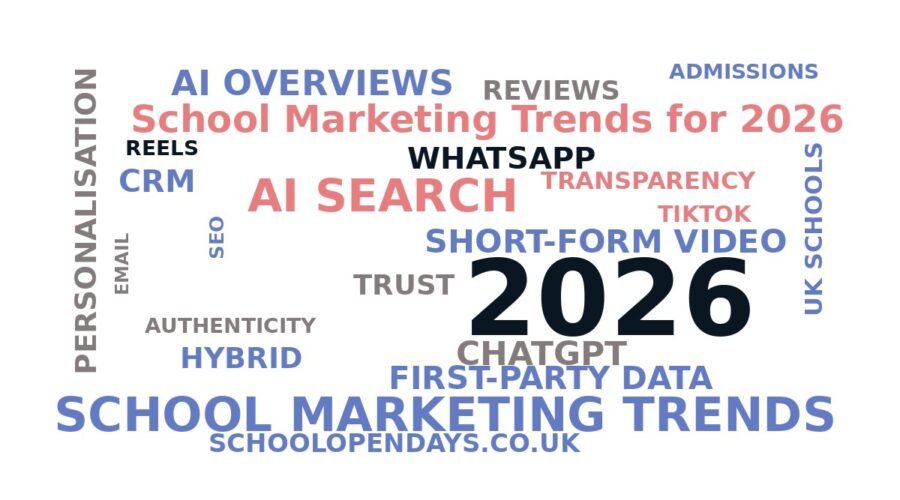
The thread connecting every 2026 trend is the same: parents want authenticity, immediacy and answers wherever they search. Schools that show up in AI-driven search, communicate on parents’ preferred channels, nurture their own data, and lead with transparency will build the strongest admissions pipelines. Listing your open days on SchoolOpenDays.co.uk is a simple way to stay visible to families — at home and overseas — wherever their search begins.