
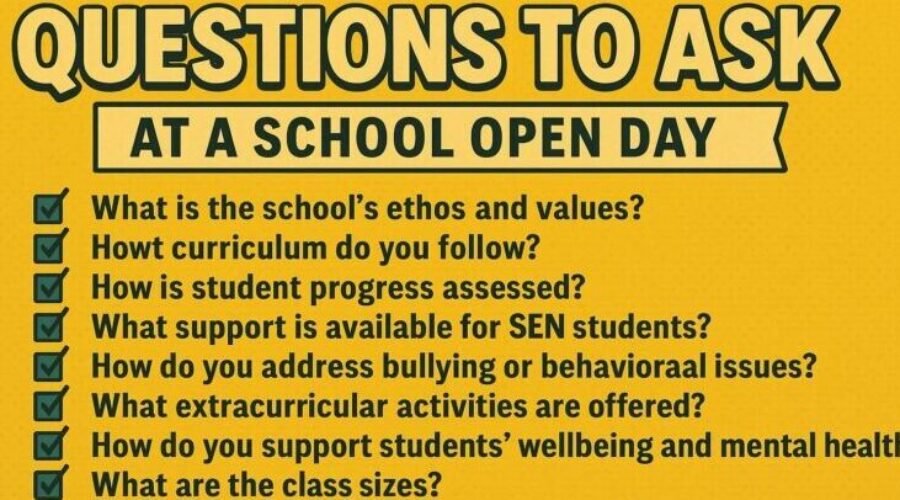
Top 10 Questions to Ask at a School Open Day in the UK
Description: Attending a school open day is one of the most important steps for parents choosing a school in the UK—whether you live locally or are considering a British education from overseas. Asking the right questions helps you gain a clearer understanding of how the school operates, what it values, and whether it’s the right fit for your child.
In this guide, we’ll share 10 insightful questions every parent should ask on a UK school open day, particularly when exploring independent (private) schools in England.
Who this is for: UK-based parents navigating private school options, as well as international families considering boarding schools or private day schools in the UK.
1. What is the school’s ethos and educational philosophy?
Start by understanding what drives the school. Is it academically focused, pastoral-led, or based on holistic child development? UK independent schools vary widely—some follow traditional academic models, while others are more progressive. This helps international and UK parents understand if the environment aligns with their child’s personality and values.
2. What curriculum does the school follow, and are there alternative pathways?
Ask whether the school follows the UK National Curriculum, GCSEs, A-levels, or offers IB (International Baccalaureate) or Pre-U. Some senior schools offer dual pathways or specialised streams. This is particularly relevant for international parents who may wish to compare with education systems back home or plan for university abroad.
3. What are the average class sizes and teacher-to-pupil ratios?
One of the major advantages of private schools in the UK is smaller class sizes. Ask about the average number of students per class in both prep and senior years. This affects personalised attention, progress tracking, and student confidence—especially helpful for pupils transitioning from other education systems.
4. What are the academic outcomes and university destinations?
Find out how students perform in public exams (GCSEs, A-levels, or IB) and where they typically go next—such as Russell Group universities, Oxbridge, or international institutions. Many UK independent schools publish leavers’ destinations, and it’s a strong indicator of academic support and ambition.
5. How is student wellbeing supported, including mental health care?
Pastoral care is a hallmark of UK private schools. Ask about the school’s wellbeing framework, mental health support, access to school counsellors, and how tutors or housemasters/mistresses monitor each pupil. For international students, this is particularly important when living away from home.
6. What extracurricular opportunities are available?
Co-curricular activities—such as sports, music, debating, drama, or Duke of Edinburgh’s Award—are deeply embedded in the UK independent school culture. Ask how children are encouraged to explore their talents and whether participation is required or optional.
7. What is the school’s approach to discipline and student behaviour?
Find out how the school handles behavioural expectations. Are there clear policies? Is the system strict, balanced, or restorative in nature? This insight helps international parents understand the cultural norms of UK school life and what’s expected from students.
8. What support is available for children with special educational needs or English as an additional language (EAL)?
If your child has SEN (Special Educational Needs) or needs EAL support, ask about specialist staff, learning support departments, and tailored provision. Many UK private schools have dedicated teams to support a wide range of learning profiles, helping international students adjust smoothly.
9. What is life like for boarders and how is their wellbeing ensured?
If you are considering a UK boarding school, ask about the types of boarding offered (full, weekly, or flexi), daily routines, guardian requirements (for overseas students), and how emotional and physical wellbeing are monitored. Good schools will have clear pastoral systems in place for boarders, including house parents and regular contact with families.
10. Can I speak to current students or parents?
Ask if you can meet or hear from current pupils—either during the tour or via a panel. Their first-hand experiences often reveal more than any brochure or website. Some schools also connect prospective international families with existing parents from the same country or region.
Bonus Tip: Take Notes and Don’t Be Afraid to Follow Up
After visiting a few schools, the details can blur together. Keep notes on your impressions, who you spoke to, and any standout answers. Most private schools in the UK welcome follow-up questions after an open day—whether you’re nearby or contacting them from abroad.
Final Thoughts: Making the Most of UK School Open Days
Choosing a private school in the UK—whether you’re based in London, elsewhere in the UK, or overseas—can feel like a big decision. But school open days offer a chance to ask meaningful questions, observe the culture, and speak directly to staff and students.
By asking the right questions, you’ll walk away feeling more informed, more confident, and one step closer to finding the right environment where your child can thrive.
Looking for the best upcoming UK school open days?
Our platform helps parents—both in the UK and abroad—discover top private schools, compare admissions, and book open days in just a few clicks.